
By Nikki Findlay, Managing Director, ETW Travel
There is a particular moment I look forward to on every trip. It comes when I turn off a busy square and into a narrow cobbled lane, the walls rising on either side in soft ochre and faded rose, washing strung between shuttered windows, and the sound of the street suddenly drops away. Nine times out of ten, when that happens in the Mediterranean, I am walking through something the Venetians left behind.
Venetian architecture is my great travel weakness. It has taken me to the lanes of Rethymno on Crete and, most recently, to Corfu Old Town, where I spent days happily lost in the tiny alleyways, stopping for a kumquat spritz whenever the mood took me. In this guide I will show you how to follow the Venetian trading routes yourself, from the ports and castles that built an empire to the holidays that bring them to life today.
What Were the Venetian Trading Routes?
For centuries, the Venetian trading routes linked Venice with Greece, the Levant, the Black Sea and, ultimately, London. Venice called its overseas possessions the Stato da Màr, the “State of the Sea”, and in various forms it lasted from around the 10th century until the fall of the Venetian Republic in 1797.
What surprised me most is that Venice rarely built these towns. Many were far older than Venice itself. Instead it conquered, bought, leased or negotiated its way into a string of ports, islands and trading quarters, then connected them with ships, warehouses, fortresses and administrators. The network included:
- Colonies ruled directly from Venice, such as Crete and Corfu
- Subject cities along the Dalmatian coast
- Island lordships granted to Venetian noble families, such as the Duchy of Naxos
- Privileged trading quarters in foreign cities, such as Constantinople and Alexandria
- Partner ports stretching west to Spain, Flanders and England
Each link in the chain supplied safe harbour, fresh water, food, ship repairs, storage and protection from pirates, ready for the next leg of the voyage.
Tracing the Venetian Trading Routes: A Merchant Voyage in 1450
Imagine you are a Venetian merchant setting sail around 1450. Your galley would travel in a state-organised convoy known as a muda, combining trade with naval protection, and your route south might look like this:
Venice > Pula > Zadar > Šibenik > Kotor > Corfu > Methoni > Koroni > Crete > Cyprus > Beirut > Alexandria
Other convoys branched to Constantinople and the Black Sea, while the Flanders galleys headed west to Bruges, Southampton and London. Spices, silk, sugar and precious stones from India, Persia and Arabia reached Venice via the Levant and Egypt, and Venice redistributed them across Europe.
That was the secret of Venetian wealth. The city produced little of the valuable cargo itself. It controlled the movement, financing, storage and insurance of goods between East and West.
Key stops on the Venetian trading routes at a glance
| Stop | Country today | Role in the network | What to see now |
| Istria (Pula, Rovinj, Poreč) | Croatia | First safe harbours south of Venice | Venetian bell towers, harbourfronts, old towns |
| Zadar | Croatia | Administrative and military hub of Venetian Dalmatia | Land Gate, city walls (UNESCO) |
| Šibenik and Trogir | Croatia | Fortified coastal towns | St Nicholas Fortress (UNESCO), Trogir’s old town |
| Kotor | Montenegro | Southern anchor of the Adriatic from 1420 | City walls climbing the mountainside (UNESCO) |
| Corfu | Greece | Gateway between the Adriatic and the Ionian from 1386 | Old and New Fortresses, Old Town (UNESCO) |
| Methoni and Koroni | Greece | The “eyes of the Republic” guarding the Peloponnese | Vast seaside castles |
| Crete (Candia) | Greece | Venetian for over four centuries; granary and staging post | Rethymno, Chania and Heraklion harbours and fortresses |
| Cyprus | Cyprus | Eastern gateway to the Levant, 1489 to 1571 | Famagusta and Nicosia walls |
The Adriatic: Where the Venetian Trading Routes Began
The Adriatic was the foundation of everything. Venice sits at its northern tip, and its long term aim was to turn the whole sea into a secure Venetian corridor.
Heading south you pass through Istria, where the harbours of Poreč, Rovinj and Pula still feel unmistakably Venetian, with the lion of St Mark carved above their gateways. Further down the Dalmatian coast come Zadar, Šibenik, Trogir and Split. Zadar’s walls and Šibenik’s St Nicholas Fortress now form part of the UNESCO listed Venetian Works of Defence.
Then there is Kotor in Montenegro, Venetian from 1420. Its fjord-like bay made a superb natural harbour, and the town walls climb the mountain behind it, past the little Church of Our Lady of Remedy, to the Fortress of San Giovanni high above the rooftops. Few places explain Venetian strategy better.

Corfu: The Gateway to the Ionian
Corfu sits like a doorway between the Adriatic and the eastern Mediterranean. Venice took permanent control in 1386 and held the island until 1797. From here galleys headed south to Greece, Crete and the Levant, or turned north for home.
Venice took Corfu extraordinarily seriously. The Old Fortress on its rocky promontory and the later New Fortress made Corfu Town one of the most heavily defended places in the Mediterranean. It withstood Ottoman sieges in 1537 and 1716, and the island never became part of the Ottoman Empire. The Old Town of Corfu was inscribed as a UNESCO World Heritage Site in 2007.
My Corfu Old Town highlights
What won me over was the atmosphere. Tall Venetian townhouses crowd over lanes barely wider than your outstretched arms, known locally as kantounia, opening suddenly into little squares with a church, a café and a table in the shade. Every shop, bar and restaurant has its own personality, from family-run tavernas to tiny jewellers tucked into old doorways.
- Get lost on purpose. The kantounia reward wandering, and you are never far from the sea to get your bearings.
- Walk the Old Fortress for views back over the town and across the water to the mainland.
- Stroll the Liston and the Spianada, Corfu’s arcaded promenade and great open square, perfect for people-watching.
- Order a kumquat spritz. Kumquats were introduced to Corfu in the 19th century and are now the island’s signature flavour. A spritz made with the local kumquat liqueur, bright orange and refreshingly bittersweet, has become my favourite way to toast the sunset.
- Try the local dishes, such as pastitsada and sofrito, which show the Venetian influence on Corfiot cooking. If food is what draws you, have a look at our food and culture holidays.

| Inspired to see Corfu Old Town for yourself? Our team has walked these streets and can tailor a stay around exactly how you like to travel, from a boutique hotel within the Old Town to a beach resort with easy day trips into town. Speak to ETW Travel today or call us on 01908 886491. |
The Peloponnese: Methoni and Koroni
On the south western tip of the Peloponnese sit Methoni (Modon) and Koroni (Coron), together known as the “eyes of the Republic”. Venice secured them after the Fourth Crusade of 1204, and ships bound for Crete, Cyprus and the Levant called in for supplies, repairs and the latest news. Methoni’s castle, with its stone bridge and octagonal sea tower, is one of the most atmospheric fortresses in Greece.
Crete: The Jewel of the Venetian Trading Routes
Crete, known to the Venetians as Candia, was arguably the jewel of the Stato da Màr. Venice held the island for more than four centuries, until Candia (modern Heraklion) fell to the Ottomans in 1669 after one of the longest sieges in history.
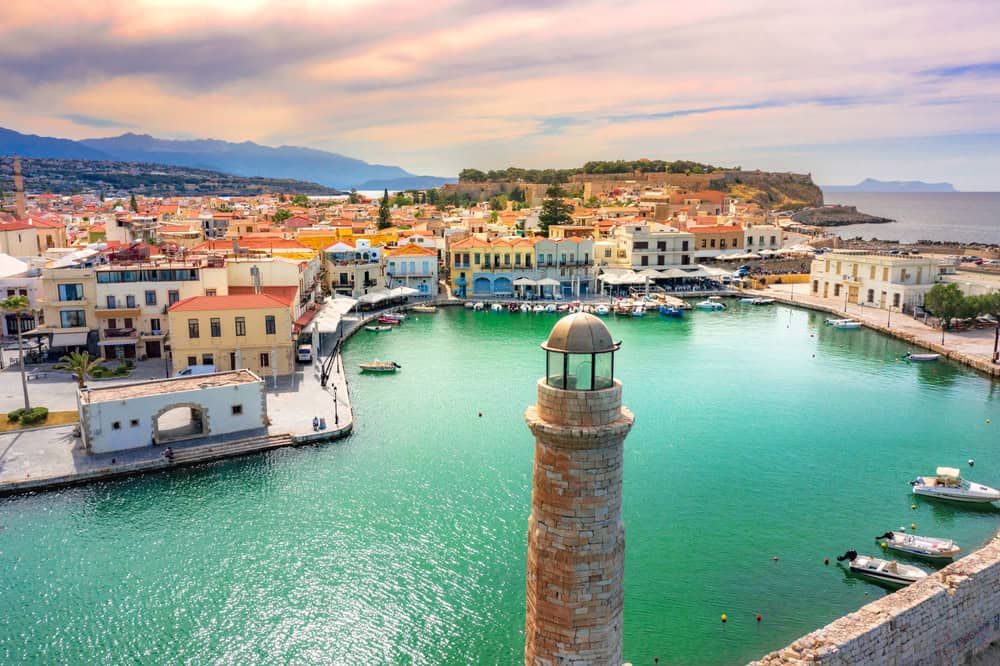
It was an agricultural powerhouse, supplying wine, olive oil, grain and sugar, and the great staging point for Venetian trade in the eastern Mediterranean. The legacy survives in three northern harbour towns: Heraklion, with its Koules fortress; Chania, with its lighthouse and pastel waterfront; and my own favourite, Rethymno.
Why I fell for Rethymno
Rethymno is one of the best preserved Venetian towns on Crete, and it feels wonderfully lived in. Its old town is a maze of narrow cobbled streets, wooden Ottoman balconies above Venetian doorways, and small squares where locals and visitors share the same café tables.
- The Fortezza, the huge Venetian citadel built in the 1570s on the hill above town, with sweeping views over the rooftops and sea.
- The Venetian harbour, small, pretty and ringed with fish tavernas, with a lighthouse at the end of the harbour wall.
- The Rimondi Fountain, a 17th century Venetian fountain where the old town’s lanes meet.
- The Venetian Loggia, once a meeting place for the town’s nobility.
- Cretan food and drink, from dakos and slow-cooked lamb to a glass of raki at the end of a meal.

Further Along the Route: The Aegean, Cyprus and Beyond
The Aegean islands
Islands including Naxos, Paros, Tinos and Milos were Venetian possessions or private lordships of Venetian noble families. The Venetian Kastro still crowns Naxos Town today.
Cyprus
Held from 1489 until the Ottoman conquest of 1570 to 1571, Cyprus was where the Venetian network met the ancient routes to India, Persia and Arabia. The walls of Famagusta and Nicosia are its enduring monuments.
Constantinople and the Black Sea
Venetian merchants held a major trading quarter in Constantinople and pushed on to Black Sea ports such as Trabzon and Caffa, where goods arrived overland from Central Asia.
Holidays Along the Venetian Trading Routes
The best way to experience the Venetian trading routes is to pick a region and savour it. Here are four ideas, beginning with the two I have fallen for myself.
1. Corfu Old Town and the Ionian
Ideal for: culture lovers, foodies and couples. Suggested stay: 7 nights.
Base yourself in or near Corfu Town to explore the Old Town, both fortresses and the Liston, then mix in beach days on the north east coast and a boat trip to Paxos. Corfu is well served by summer flights from UK airports, and we will check the best options from your preferred airport, including London Luton.
Best time to go: May, June and September, when it is warm enough for the beach and comfortable for exploring the Old Town on foot.
2. Rethymno and Western Crete
Ideal for: families, history lovers and anyone wanting beaches and culture in one. Suggested stay: 7 to 10 nights.
Stay in Rethymno’s old town or on the long sandy beach just east of it. Explore the Fortezza and harbour, spend a day in Chania’s Venetian quarter and head inland to mountain villages. Add Heraklion for the Koules fortress and the Minoan palace of Knossos. Travelling with children? Read about Jayne’s Crete trip on our family holidays blog.
Best time to go: May to June and September to October, avoiding the peak heat of July and August.
3. The Venetian Adriatic: Split, Zadar and Kotor
Ideal for: multi-centre explorers. Suggested stay: 10 to 14 nights.
Combine the UNESCO fortifications of Zadar and Šibenik with Trogir and Split, then continue south to the Bay of Kotor in Montenegro, walking the Adriatic backbone of the network one old town at a time. Our touring holidays team can piece together every transfer.
Best time to go: May, June and September, when the old towns are quieter and the sea is warm.
4. The Grand Venetian Voyage
Ideal for: those with time to travel slowly. Suggested stay: 2 to 3 weeks, or a small ship cruise.
Follow the historic sequence of Venice, Istria, Dalmatia, Kotor, Corfu, the Peloponnese, Crete, Cyprus and Istanbul, tracing the skeleton of a medieval maritime empire through six countries. A cruise is often the easiest way to do it, and our cruise holidays page is a good place to start.
Best time to go: Late spring or early autumn, when Mediterranean cruise itineraries are in full swing but the heat is gentler.
Before You Travel
Always check the latest official guidance before you book and again before you go. The UK Foreign, Commonwealth and Development Office publishes up to date advice for Greece, Croatia, Montenegro and Cyprus, including entry requirements and local laws. Pack good walking shoes too: those beautiful cobbles and fortress steps are part of the charm, but hard work in flip-flops.
Frequently Asked Questions
What were the Venetian trading routes?
They were the sea lanes and chain of ports Venice used, from around the 10th century to 1797, to move goods between Western Europe, the Byzantine world, the Levant and, indirectly, Asia. Key stops included Dalmatia, Corfu, the Peloponnese, Crete and Cyprus.
Which Greek islands have Venetian architecture?
Corfu and Crete have the richest Venetian heritage, particularly Corfu Old Town, Rethymno, Chania and Heraklion. Naxos and several other Aegean islands also have Venetian castles and quarters.
Is Corfu Old Town a UNESCO World Heritage Site?
Yes. The Old Town of Corfu, including its Venetian fortifications, was inscribed on the UNESCO World Heritage List in 2007.
What is Corfu’s kumquat spritz?
A refreshing aperitif made with Corfu’s kumquat liqueur, the island’s signature local drink. Kumquats have been grown on Corfu since the 19th century.
Plan Your Venetian Trading Routes Holiday with ETW Travel
The Venetians built their fortune by knowing every harbour, every safe anchorage and every trusted partner along the route. We work the same way. With 115 years of collective experience across our team, and the independence of being family-owned under the Barrhead Travel umbrella, we plan holidays around you rather than a brochure.
Whether you are dreaming of a kumquat spritz in a Corfu square, sunset over Rethymno’s harbour or the full voyage from Venice to Cyprus, I would love to help you discover it.
| Ready to follow the Venetian trading routes? Get in touch with ETW Travel, call us on 01908 886491, email woburn@etwtravel.co.uk or pop in to see us in Woburn Sands, Milton Keynes. |
Recent Comments